Trump DOJ readies 1,000 election monitors for midterms
3 of 3 free articles left this month.
0/3The Trump administration plans to deploy approximately 1,000 Department of Justice election monitors across the country in November.
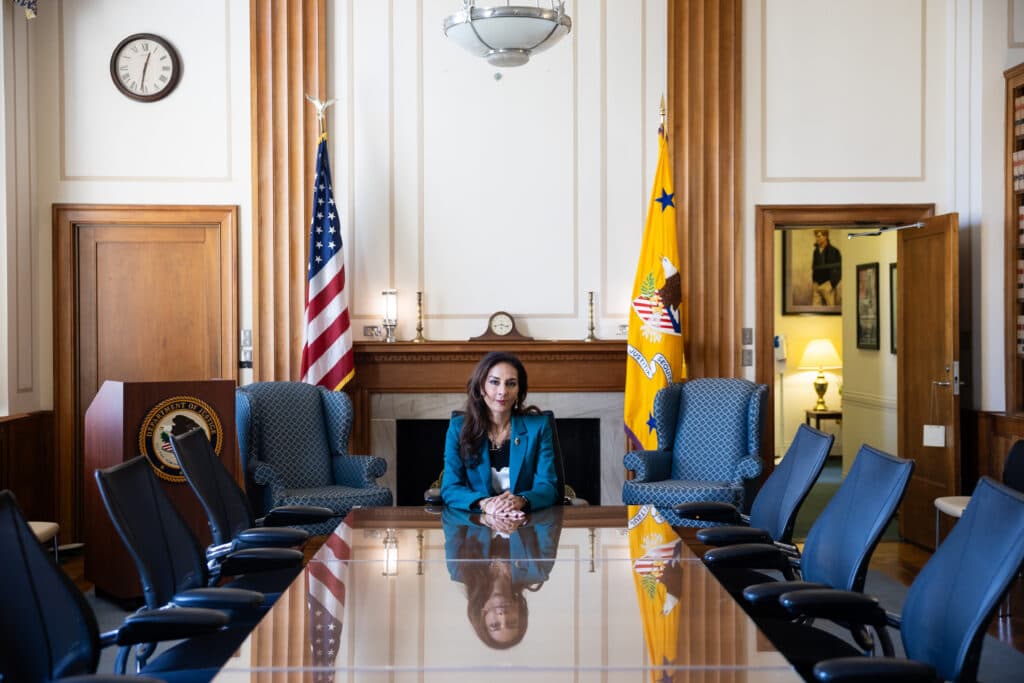
The Trump administration plans to deploy approximately 1,000 Department of Justice election monitors across the country in November, Assistant Attorney General Harmeet Dhillon said Monday.
In an interview on Bloomberg’s Balance of Power, Dhillon also said the Justice Department could take its failing campaign to obtain unredacted state voter rolls all the way to the U.S. Supreme Court if necessary.
Sign up today
Get updates straight to your inbox — for free
Join 350,000 readers who rely on our daily and weekly newsletters for the latest in voting, elections and democracy.
Dhillon’s interview offered one of the clearest previews yet of how the department’s Civil Rights Division intends to approach the 2026 midterms.
Join 350,000 readers who rely on our daily and weekly newsletters for the latest in voting, elections and democracy.
“We began our election security work almost as soon as I was sworn in last April. This is an ongoing duty and obligation,” Dhillon said. “The United States Department of Justice Civil Rights Division has sent monitors to election hot spots, polling places to increase voter confidence to troubleshoot problems and we are doing that now. We just did it in the primary. We’re going to do it to the tune of approximately a thousand election monitors in the November election, and this is just something that DOJ does.”
DOJ has not yet released its final list of jurisdictions where the monitors will be sent. Dhillon said the department is considering jurisdictions with potential language or disability-access problems and places where DOJ believes there may be voter fraud.
“There’ll be some prosecutions in the pipeline of people who voted illegally who should not have, and we see a problem frankly with some election officials refusing to clean up their voter rolls and knowingly allowing non-citizens for example to stay on the voter rolls,” Dhillon said “This is a federal crime, and so we reminded people of that but overall the goal is not so much going after one voter here or there.”
It was not immediately clear who will make up the approximately 1,000-person monitoring force. DOJ election monitors generally observe polling place procedures and assess compliance with federal voting laws; they do not administer elections, determine voter eligibility or direct local election officials.
The Civil Rights Division, itself, is far smaller than that 1,000 person figure, but DOJ could potentially draw personnel from U.S. attorneys’ offices and other components of the department for election monitoring.
Dhillon’s comments come as the department refuses to retreat from its sweeping voter roll campaign despite a steady stream of losses in federal court.
DOJ has lost all 23 district court cases in which judges have ruled on its effort to use Title III of the Civil Rights Act of 1960 to force states to provide their full statewide voter-registration databases, including sensitive information such as driver’s license and Social Security numbers.
The Sixth Circuit Court of Appeals has also rejected DOJ’s position, and on Friday the full appeals court declined the department’s request to rehear the case.
“This is an ongoing project, and there definitely have been courts that have not agreed with our efforts, and so we are appealing some cases,” Dhillon said. “We just got a ruling in the Sixth Circuit that had some very good language in the en banc from several very respected judges, and so you may see us making a next stop at the Supreme Court on that.”
Her comments came one day after Attorney General Todd Blanche similarly said Sunday that seeking Supreme Court review was “a possibility.”